
How much data does cloud gaming use? (per hour, per service, per month)


If you are on a capped broadband plan or playing on mobile, data usage is the first thing you need to understand about cloud gaming. It uses between 4 GB and 20 GB per hour depending on your service and settings. Playing two hours a day at 1080p will consume between 240 and 660 GB per month.
How much data does cloud gaming use per hour?
Instead of rendering locally, where your hardware only sends tiny input packets, cloud gaming streams high-resolution video in real time. This makes data usage an order of magnitude higher than traditional online play (which typically uses less than 300 MB per hour).
Resolution and frame rate are the primary drivers. The jump from 1080p/60fps to 4K/120fps represents roughly eight times the raw pixel data per second before compression. Codecs also matter: modern AV1 compression delivers equivalent visual quality at roughly half the bitrate of older H.264.
| Resolution | Frame rate | Approx. GB/h |
|---|---|---|
| 720p | 30fps | 1–2 GB |
| 720p | 60fps | 2–5 GB |
| 1080p | 30fps | 4–6 GB |
| 1080p | 60fps | 7–11 GB |
| 1080p | 120fps | 12–18 GB |
| 1440p | 60fps | 11–16 GB |
| 4K | 60fps | 15–23 GB |
| 4K | 120fps | 18–22 GB |
How much data does each cloud gaming service use?
Not every service uses data at the same rate, even at identical resolutions. Bitrate targets, codec choices, and manual settings all make a real difference. Services like GeForce Now and Shadow PC publish explicit GB per hour estimates within their apps; we derive all other values from each service’s official bandwidth requirements.
Where available, in-app estimates take preference over derived figures, as real-world compression consistently produces lower consumption than raw bitrate calculations imply.
| Service | Max quality | GB/h at 1080p | GB/h at max quality |
|---|---|---|---|
| GeForce Now | 5K / 120fps | ~9 GB | ~9–22 GB |
| Xbox Cloud Gaming | 1440p / 60fps | ~5–9 GB | ~5–14 GB |
| Amazon Luna | 1080p / 60fps | ~10 GB | ~10 GB |
| Boosteroid | 4K / 120fps | ~7–16 GB | ~7–18 GB |
| Shadow PC | 4K / 60fps | ~11 GB | ~11–28 GB |
| PlayStation Cloud | 4K / 60fps* | ~7–10 GB | ~7–23 GB |
| airgpu | 4K / 60fps | ~11 GB | ~11–18 GB |
*PlayStation Cloud’s 4K tier requires a PS5 console. PC and PS Portal top out at 1080p/60fps. For more details, see our PlayStation Cloud Gaming guide.
Most cloud gaming services adapt stream quality dynamically to match your available bandwidth. GeForce Now and Shadow PC additionally offer a manual bitrate cap: GeForce Now tops out at 75 Mbps (in-app estimate: ~9 GB per hour at 1080p, ~22 GB per hour at maximum settings), Shadow PC at 70 Mbps (up to ~28 GB per hour).
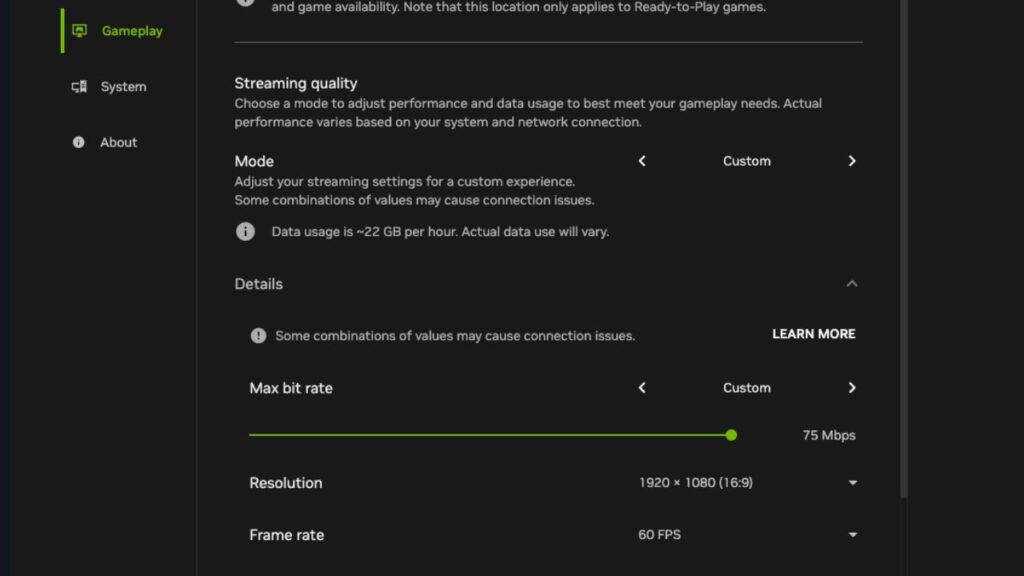
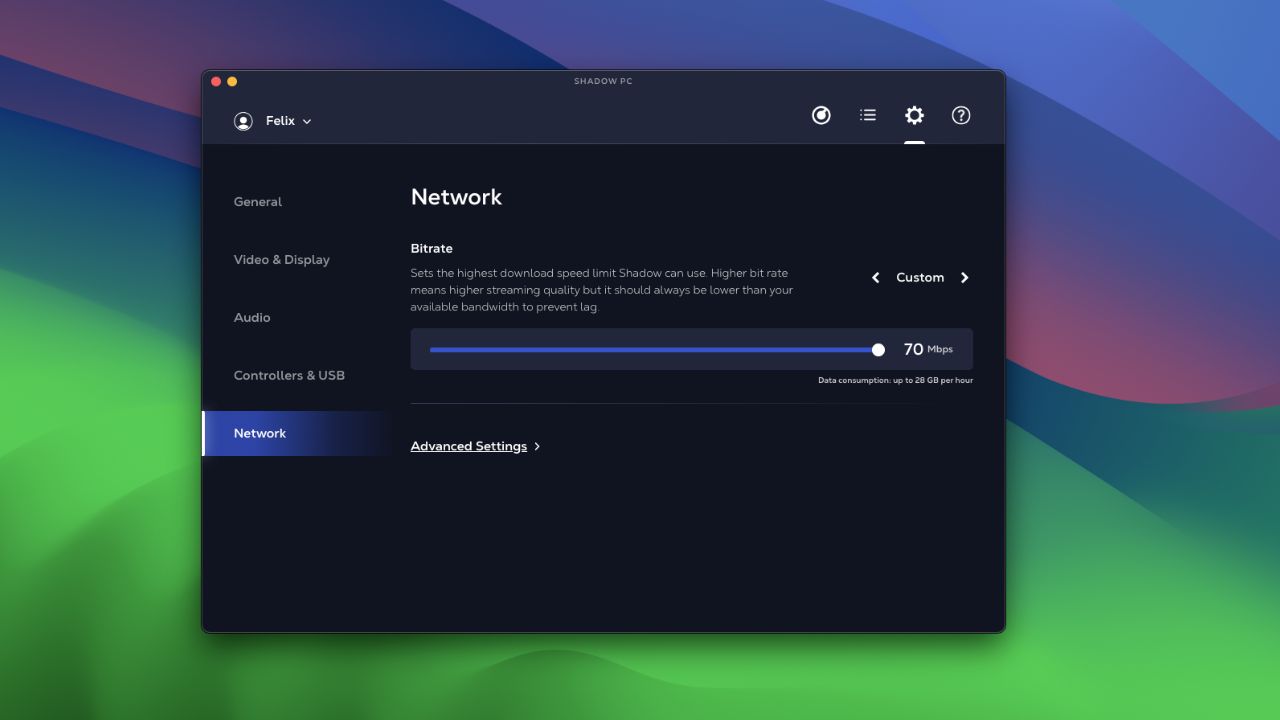
Boosteroid and Amazon Luna offer resolution and frame rate selection but no bitrate slider. Note that GeForce Now’s 5K option requires the native PC or Mac app and a compatible display.
Microsoft recommends 20 Mbps for Xbox Cloud Gaming, corresponding to approximately 9 GB per hour. The 1440p tier, exclusive to Game Pass Ultimate since early 2026, can reach up to 14 GB per hour but currently covers only a subset of games. Game Pass Essential and Premium are capped at 1080p. If your data allowance is tight, 1080p is the safer choice.
To see which services carry the specific games you want to play, search on cloudbase.gg.
Does cloud gaming use more data than video streaming?
Yes, significantly. Video streaming uses pre-encoded footage that allows for aggressive compression. Cloud gaming must encode every frame live as you play, which requires a much higher sustained data rate.
| Activity | Resolution | Approx. GB/h |
|---|---|---|
| Local gaming (PC or console) | n/a | ~0.05–0.3 GB |
| Netflix | 1080p | ~3 GB |
| Netflix | 4K | ~7 GB |
| YouTube | 1080p/60fps | ~3 GB |
| Xbox Cloud Gaming | 1080p/60fps | ~5–9 GB |
| Amazon Luna | 1080p/60fps | ~10 GB |
| GeForce Now | 4K/120fps | ~22 GB |
How much data does cloud gaming use per month?
If you grind ranked matches or run long sessions at weekends, the regular column is where you sit.
| Service and quality | Casual (30 hrs/month) | Regular (90 hrs/month) |
|---|---|---|
| Xbox Cloud Gaming at 1080p | ~150–270 GB | ~450–810 GB |
| PlayStation Cloud at 1080p | ~210–300 GB | ~630–900 GB |
| Amazon Luna at 1080p | ~300 GB | ~900 GB |
| GeForce Now at 1080p | ~270 GB | ~810 GB |
| Boosteroid at 1080p | ~210–480 GB | ~630–1,440 GB |
| GeForce Now at 4K | ~450–660 GB | ~1,350–1,980 GB |
| Shadow PC at maximum bitrate | up to ~840 GB | up to ~2,520 GB |
Some US cable broadband providers cap monthly data at 1.2 TB. A regular player on GeForce Now at 4K, or Shadow PC near maximum bitrate, can hit or exceed that cap in a single month.
On mobile, one hour at 1080p can exhaust most plans in a single session. Treat mobile as a 720p experience and save 1080p for home. Our mobile cloud gaming guide covers which services and settings work best over 5G.
How to use less data while cloud gaming
- Lower your resolution. Dropping to 720p roughly halves consumption on most services, with minimal visual impact on phone and tablet screens. Look for a resolution or video quality option in your service’s settings.
- Enable AV1 if supported. Boosteroid launched AV1 support in May 2025, delivering equivalent visual quality at roughly half the data usage of H.264. In Boosteroid’s settings, enable “AV1 codec if available.” If stream quality degrades after enabling it, turn it off.
- Set a manual bandwidth cap. On GeForce Now (Settings, Streaming Quality, set Mode to Custom, then adjust Max Bitrate) or Shadow PC (Quick Menu, Network tab), limiting to 15 to 20 Mbps cuts data use substantially with minimal quality loss for most single-player or slower-paced games.
- Monitor your actual usage. On Windows, use Task Manager (Performance, then Open Resource Monitor) to track per-app consumption in real time. Your ISP app shows your total monthly progress toward your cap.
For internet speed requirements, latency, and connection tips, see our cloud gaming internet speed requirements guide.
Frequently asked questions


You might also like
-
 Best cloud gaming handhelds in 2025Last updated: October 28, 2025
 -
 Best controller for cloud gaming in 2025Last updated: May 16, 2025
 -
 Cloud Gaming Android: How to Play on Smartphone & Tablet [2024]Last updated: January 9, 2024


You might also like
-
 airgpu Cloud GamingLast updated: June 14, 2024
 -
 Best Cloud Gaming Services in 2026 [Complete List]Last updated: February 26, 2026
 -
 Boosteroid Cloud GamingLast updated: June 13, 2024


